




Every week, I review the latest sports nutrition and exercise research to understand what the findings mean for athletes. This week, a randomized crossover trial compared heavy back squats and barbell hip thrusts before jumping, sprinting, and agility tests.
The study
Researchers recruited 20 male collegiate basketball players to test post-activation performance enhancement, or PAPE.
This describes a temporary improvement in performance that can occur after a conditioning activity, such as a heavy lift, followed by recovery.
Each athlete completed three conditions:
-
A back squat protocol
-
A barbell hip thrust protocol
-
A basketball-specific control warm-up
For both lifting conditions, athletes performed four sets of three repetitions at 80% of their one-repetition maximum. They then rested passively for eight minutes before testing.
Researchers assessed countermovement jump height, approach vertical jump height, standing long jump distance, sprint splits, and performance on the T-test and hexagon agility test.
Because each athlete completed every condition, the researchers could compare how the same players performed after the different warm-ups.
The results
The back squat protocol produced better results on some jump tests.
Countermovement jump height and approach vertical jump height were significantly higher after back squats than after either hip thrusts or the control warm-up.
Standing long jump distance was also significantly greater after squats than after the control. However, the study did not establish a significant squat-versus-hip-thrust advantage for that test.
The hip thrust condition did not significantly outperform the control on any of the reported performance tests.
Sprint splits, T-test performance, and hexagon agility performance showed no significant differences between conditions.
So, the benefits were specific: the squat protocol helped certain jump outcomes, but it did not demonstrate a broader improvement in sprinting or agility.
Why it matters
A heavy lift before an explosive effort can be useful, but the choice of exercise and the recovery period may matter.
This study suggests that back squats may be more effective than hip thrusts for preparing trained basketball players for vertical jumping under this particular protocol.
For strength and hybrid athletes, the wider lesson is to match the warm-up to the task. A protocol that improves jumping shouldn't automatically be expected to improve sprinting or a full mixed-modality workout.
My thoughts
I'd call this interesting enough to test in training, rather than a reason for everyone to add heavy squats to their warm-up.
The researchers studied 20 trained male basketball players using one loading prescription and one rest interval. We don't know whether the same approach would help athletes with different backgrounds or levels of strength.
Four sets at 80% of your maximum is also a meaningful amount of lifting. The eight-minute recovery period was part of the protocol, not an incidental detail.
If jumping is your priority and you're already comfortable with heavy squats, this could be something to explore with your coach. Compare it with your usual warm-up under similar conditions and see whether you consistently perform better.
If sprinting is the goal, this study gives you no clear reason to expect an improvement. A warm-up earns its place by helping the effort that follows.
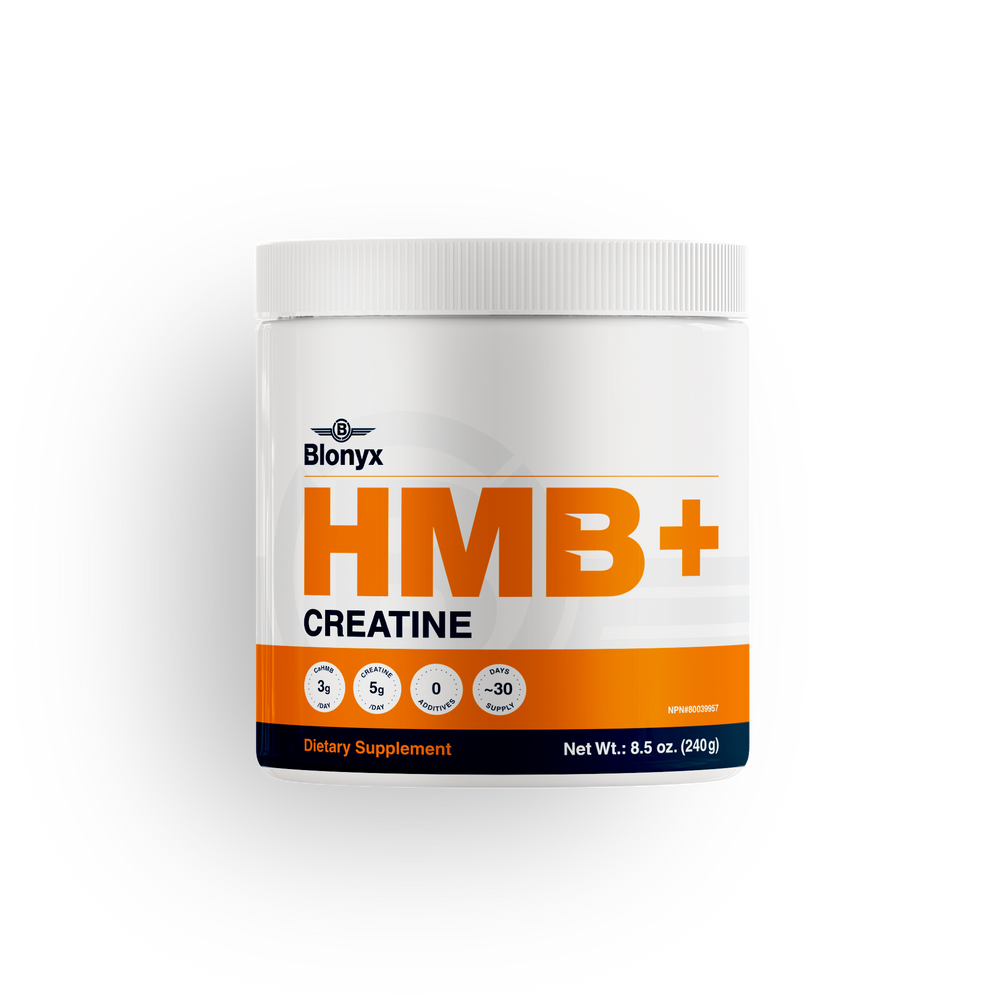
I'd also think about how you're supporting strength and power development between sessions. Creatine, found in Blonyx HMB+ Creatine, can support high-intensity training and strength gains over time when combined with resistance training.
That's a separate benefit from the warm-up effect studied here. Consistent daily use is what matters; taking a serving just before jumping isn't a substitute for a warm-up that works for you.
Want more practical research breakdowns? Sign up for the Blonyx Research Update.