




You see white streaks on your jersey and decide you’re a salty sweater. Here’s why that’s probably wrong, and what matters far more for your performance.
I used to think I was a salty sweater. After football, I’d find white lines of salt on my forehead, and I took that as proof. So I did what a lot of athletes do: I added more salt to my food and loaded up on high-salt electrolyte drinks.
Then I dug into the science properly, as an exercise physiologist, and realised I’d got it backwards. I wasn’t losing too much salt. I was focused on the wrong problem.
Here’s our position: you’re probably not a salty sweater. And when you train or race hard, for most athletes, water loss is a much more immediate threat to performance than running low on sodium. Let’s look at why.
What’s Actually in Your Sweat?
Sweat tastes salty, so it’s easy to assume it’s draining your salt stores. But sweat is much less salty than your blood.
Your blood holds sodium at around 135–145 mmol/L. In a study of 506 athletes across team and endurance sports, whole-body sweat sodium averaged about 36 mmol/L. Even the saltiest sweat in the group, at about 71 mmol/L, was only half as concentrated as blood. Sweat varies with heat, fitness and heat acclimation, but it’s almost always far more dilute than blood.
Even the saltiest sweat in 506 athletes was half as salty as blood.
| Fluid | Average or midpoint | Full range |
| Athletes’ sweat (506 athletes) | 36 (average) | 18–71 |
| Blood (normal range) | 140 (midpoint) | 135–145 |
Sodium concentration (mmol/L). Sweat: Baker et al. (2016), Journal of Sports Sciences, predicted whole-body sweat sodium in 506 athletes, mean and range. Blood: normal reference range.
So every litre of sweat takes proportionally more water than salt. The result surprises most athletes: when you sweat without drinking, the sodium concentration in your blood usually goes up, not down. You’re not running out of salt. You’re running out of water.
You do lose some sodium, of course. But for many athletes in normal training, those losses are readily replaced through regular meals. Bread, cheese, cereals, soups and most savoury foods carry plenty, and most adults already eat more sodium than health guidelines recommend.
You’re not running out of salt. You’re running out of water.
Why Salt Marks Don’t Make You a Salty Sweater
Most athletes who call themselves salty sweaters decide it from what they see: white rings on a cap, crusty streaks on a jersey, grit on their skin after a long ride.
The problem is that salt marks measure the total amount of salt you left behind, not how salty your sweat is. And total salt depends mostly on how much you sweat.
Think of two riders on the same climb:
- Rider A sweats 0.8 litres an hour at a moderate sodium concentration.
- Rider B sweats 1.6 litres an hour at the same concentration.
Rider B leaves twice the salt on their kit. Their sweat isn’t any saltier. They simply sweat more. Hot days, hard efforts, dark clothing and a long session all make the marks easier to see too.
Large datasets show the same pattern. In a study of 1,303 athletes, the sports with the highest sweat rates (American football and endurance) also lost the most sodium per hour.
So heavy salt marks usually tell you one thing: you’re a heavy sweater. And that points to water as your bigger concern, not salt.
The only way to know your actual sweat sodium concentration is a properly run sweat test. Even then, results vary with the method used and the conditions on the day.
Salt marks don’t measure how salty your sweat is. They measure how much you sweat.
The Real Risk: Losing Water, Not Salt
Some of the water you sweat comes from your blood plasma. Lose enough of it and your blood volume drops.
That sets off a chain your body has to work hard against:
- Your heart works harder. Less blood returns to the heart, so each beat pumps less and your heart rate climbs to keep up.
- You get hotter. There’s less blood to carry heat to the skin, so your core temperature rises faster.
- Efforts feel harder. The same pace or power costs more, and it shows up in your performance.
The American College of Sports Medicine uses around 2% of body weight as a practical upper guardrail. Performance tends to decline as dehydration becomes more substantial, especially in the heat. For a 70 kg athlete, 2% is just 1.4 kg.
What about low sodium?
Low blood sodium during exercise (exercise-associated hyponatremia) is real, but it’s uncommon. It mostly shows up in long events. And the main cause isn’t sweating out too much salt. It’s drinking too much fluid, well beyond what you’re losing, which dilutes the sodium in your blood.
Low blood sodium during exercise is usually driven by drinking more fluid than you’re losing, which dilutes the sodium in your blood. Simply adding more sodium doesn’t make overdrinking safe. The priority is avoiding excessive fluid intake in the first place.
Around 2% body-weight loss is a useful upper guardrail, especially in the heat.
What We’d Do Instead
If you want to protect your performance, focus on water first. Here’s how.
- Find your sweat rate. Weigh yourself before and after a typical hour of training, in minimal clothing. Each kilogram lost is about a litre of sweat. Add back what you drank during the session.
- Use 2% as a practical upper guardrail. Use your sweat rate to plan how much to drink so you aim to finish no more than about 2% lighter. You don’t need to replace every drop. A small loss is well tolerated, and some researchers argue it may even help (we cover this in tactical dehydration).
- Never finish heavier than you started. Gaining weight during a session means you drank more than you lost. That’s the pattern behind low blood sodium.
- Drink water with a little sodium and sugar. Your small intestine absorbs water faster when sodium and glucose arrive together, through a transporter called SGLT1. You don’t need a salt bomb. You need enough of each to switch that system on.
- Get your salt from food. Normal meals after training replace the sodium you lost. There’s no need to load up on salt beforehand.
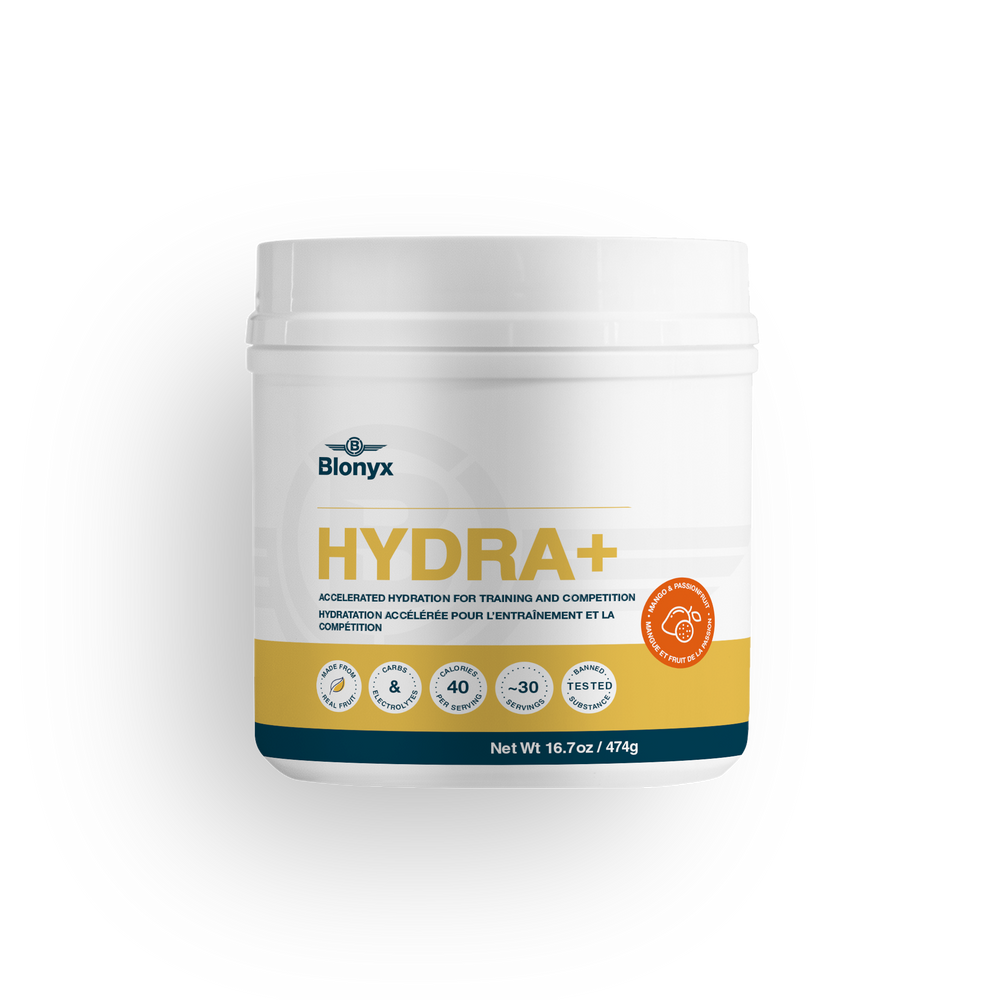
That’s how Hydra+ came about. Once we understood this, we experimented to see if we could make a solid hydration drink from real foods, and make it taste good enough that you’d actually want to drink it. It isn’t flashy, and it doesn’t pack a gram of salt. Each serving has 130 mg of sodium and 11 g of carbohydrate from fruit juice, coconut water, sea salt and organic cane sugar. Sodium and glucose are absorbed together in the small intestine through SGLT1, one of the mechanisms your body uses to absorb fluid. The goal isn’t to pack in as much salt as possible. It’s to pair fluid with carbohydrate and some sodium while keeping the focus on hydration.
Water first. A little sodium and sugar to get it in. Salt from your meals.
Our Take
The salty sweater idea took a small truth (people do vary in sweat sodium) and stretched it into a story most athletes now believe about themselves. Salt stains got treated as proof. High-sodium products got sold as the fix.
We think that’s mostly hype, and it pulls attention away from what actually costs you on race day.
So here’s our call. For most athletes, a practical goal is to keep water loss to around 2% of body weight or less, and to drink water, sodium and sugar together so it gets absorbed quickly. Get the rest of your salt from your meals.
If you’ve had a proper sweat test that shows genuinely high sweat sodium, or you race for many hours in serious heat, your needs may be higher. Work those out with your coach or a sports dietitian. For everyone else, stop worrying about the stains and watch the scale.
Build your race-day hydration around Hydra+.
Resources
- Sawka, M. N., Burke, L. M., Eichner, E. R., Maughan, R. J., Montain, S. J., & Stachenfeld, N. S. (2007). American College of Sports Medicine position stand: Exercise and fluid replacement. Medicine & Science in Sports & Exercise, 39(2), 377–390. https://doi.org/10.1249/mss.0b013e31802ca597
- Baker, L. B., Barnes, K. A., Anderson, M. L., Passe, D. H., & Stofan, J. R. (2016). Normative data for regional sweat sodium concentration and whole-body sweating rate in athletes. Journal of Sports Sciences, 34(4), 358–368. https://doi.org/10.1080/02640414.2015.1055291
- Barnes, K. A., Anderson, M. L., Stofan, J. R., et al. (2019). Normative data for sweating rate, sweat sodium concentration, and sweat sodium loss in athletes: An update and analysis by sport. Journal of Sports Sciences, 37(20), 2356–2366. https://doi.org/10.1080/02640414.2019.1633159
- Baker, L. B. (2017). Sweating rate and sweat sodium concentration in athletes: A review of methodology and intra/interindividual variability. Sports Medicine, 47(Suppl 1), 111–128. https://doi.org/10.1007/s40279-017-0691-5
- Hew-Butler, T., Rosner, M. H., Fowkes-Godek, S., et al. (2015). Statement of the Third International Exercise-Associated Hyponatremia Consensus Development Conference, Carlsbad, California, 2015. Clinical Journal of Sport Medicine, 25(4), 303–320. https://doi.org/10.1097/JSM.0000000000000221